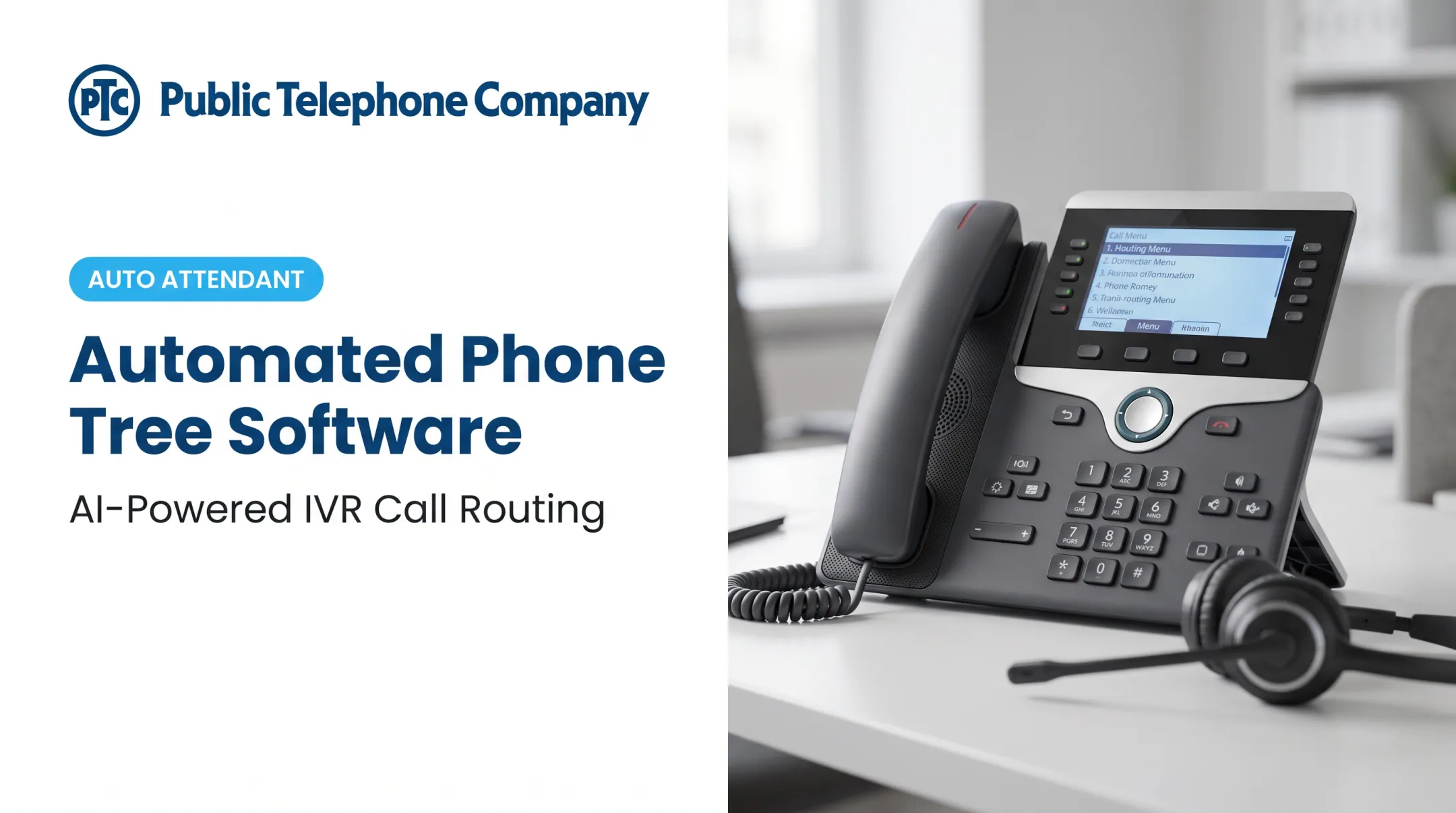
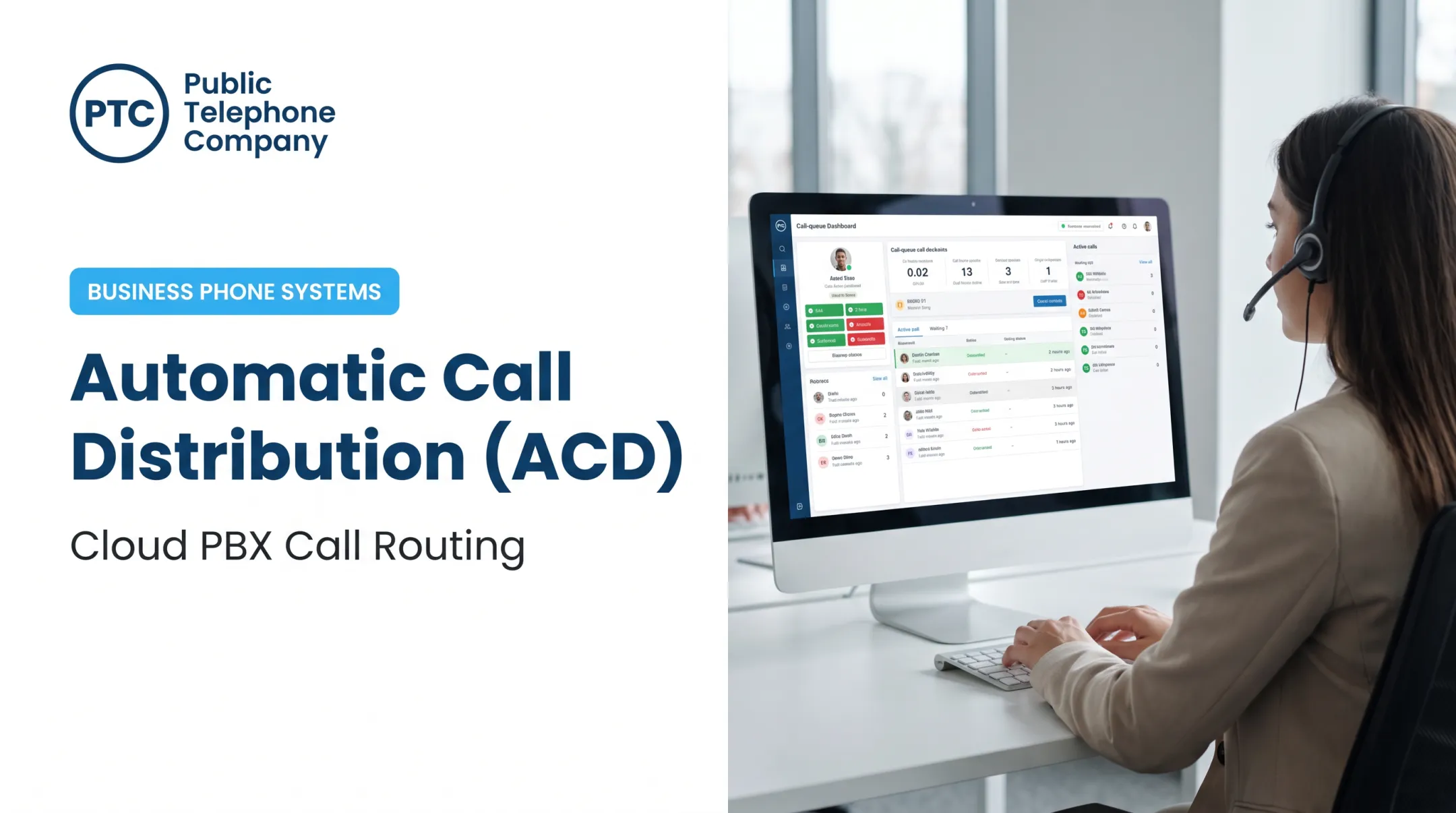
That's the split between IVR (Interactive Voice Response) and ACD (Automatic Call Distribution). Both often live inside the same cloud phone system, which is exactly why business owners mix them up.
Confusing the two has real costs. Businesses end up with menus that ask questions nobody uses, routing rules that ignore what the caller actually needs, or callers stuck in the wrong queue entirely. The result: longer waits, unnecessary transfers, and a phone system that doesn't match how the business actually operates.
This article breaks down what each technology does, where they overlap, and how to decide what your business needs when evaluating a hosted VoIP or cloud communications platform.
Key Takeaways
- ACD routes incoming calls to agents, queues, or departments using rules like availability, skills, and time of day.
- Callers use IVR through keypad or voice prompts to collect information and offer self-service.
- IVR typically identifies why someone is calling; ACD decides where that call goes next.
- Weigh menu design, routing complexity, integrations, and call volume before you choose a platform.
ACD vs IVR: Quick Comparison
Side-by-side, the two systems differ in role, interaction, and outcome:
| Aspect | ACD | IVR |
|---|---|---|
| Function | Routes calls to the best available agent, department, or queue | Plays prompts, collects keypad or speech input, and can finish self-service tasks |
| Caller interaction | Background system; callers rarely notice it | Direct interaction through menus, recordings, or speech |
| Decision logic | Agent availability, skills, priority, hours, queue status | Caller’s own selections and responses |
| Primary outcome | Balanced workloads and the right connection | Faster intake, self-service, and guided call flows |
| Relationship | Often uses IVR data to route smarter | Usually the first step before ACD routing |
Vendor caveat: labels and feature packs differ. Some platforms fold ACD and IVR into one auto-attendant; others sell them as separate add-ons. Ask the vendor to show which screens handle menu prompts versus agent/queue routing before you buy.
What Are ACD and IVR?
Automatic Call Distribution (ACD)
ACD is the engine that automatically sends inbound calls to the right agent, team, queue, voicemail box, or callback option. It matters most once a business handles more than one call type, department, or skill level.
Common ACD routing methods include:
- Skills-based routing — sends calls to agents with the relevant expertise (billing, technical support, a specific language)
- Round-robin or workload balancing — spreads calls evenly across a team
- Longest-idle routing — connects the caller to whoever has waited longest without a call
- Priority queues — moves VIP or urgent calls ahead in line
- Time-of-day and overflow rules — reroutes calls after hours or during volume spikes

Standard ACD handles the basics well. Advanced features like real-time skills weighting or predictive routing usually sit on a higher platform tier—confirm what your plan includes.
When no agent is free, ACD manages the wait: queue placement, hold announcements, estimated wait time, voicemail, callback requests, or overflow to a backup team. Done poorly, this is where callers hang up. Done well, it's where they barely notice they waited at all.
A 2023 study at Edward Hines, Jr. VA Hospital implemented ACD splits for an inpatient pharmacy line—one for technicians and one for clinical pharmacists—distributing calls algorithmically. Over 12 months, abandonment stayed near 4.7% and mean answer time landed around 13–16 seconds for both groups. One healthcare setting is not a universal benchmark, but it shows what disciplined ACD routing can do for workload balance.
Many ACD systems also connect to CRM platforms, so routing can factor in caller history, account tier, or prior interactions. Integration depth varies, so confirm CRM routing capabilities during evaluation rather than assuming parity.
IVR (Interactive Voice Response)
IVR is the automated voice layer that talks to callers through recorded menus, keypad entry, or speech recognition. It can identify why someone is calling, collect an account number, verify identity, announce business hours, give a status update, or accept a basic payment.
Basic menu IVR asks callers to "press 1 for sales, press 2 for support." Advanced, data-connected IVR can pull account data mid-call or understand natural speech. Either approach fails fast when menus are poorly worded, options are buried, or there is no clear path to a human.
IVR's real value shows up when it hands data to ACD. Once the system knows a caller needs billing versus technical support, ACD can route accordingly instead of guessing.
McKinsey's research on IVR redesign describes one North American financial institution whose IVR handled over 10 million requests a year—about half its total call volume—saving roughly $100 million annually versus agent-handled calls.
After a customer-centric redesign that used caller language instead of internal process labels, containment rose another 2–5% and satisfaction improved 10–25% on the affected call types. The example is specific, not a guarantee—but it underscores that menu wording matters as much as menu logic.
Use Cases of ACD and IVR
Different businesses lean on these tools differently:
- Medical or dental practices — IVR sorts appointment vs. billing calls; ACD routes each to reception, scheduling, or after-hours
- Law firms and professional services — IVR identifies the department; ACD sends urgent or specialized matters to the right staff
- Multi-location businesses or government offices — combine hours, location, language, and overflow rules so callers hit the right office without transfer loops
- Small businesses — start with a short IVR menu and basic routing, then add queues, integrations, and reporting as volume grows
ACD vs IVR: What Is Better?
Neither technology is universally "better." The real question is which problem you're solving.
Prioritize IVR if your main need is:
- Structured caller intake or basic self-service
- Business-hours announcements
- Caller authentication before a human conversation
- Collecting account details upfront
Prioritize ACD if your main need is:
- Distributing calls across multiple agents or teams
- Managing queues during busy periods
- Routing by skill, priority, or language
- Balancing workload across departments
Most growing businesses eventually need both. Several call types, specialized teams, peak-volume periods, or multiple locations usually mean IVR and ACD work better together—matching caller intent to the right available agent.
A quick selection checklist before you buy:
- What's your current and peak call volume?
- How many departments or call types exist?
- Does routing need to consider skills, priority, or language?
- Do you need self-service, or just structured intake?
- What CRM or business systems need to connect?
- What reporting, accessibility, and security requirements apply?
- Can the system add users and locations as you grow?
Cloud-hosted VoIP and unified communications platforms make this easier to evaluate. Instead of a large on-site PBX, you can combine phone service, extensions, IVR, and ACD-style routing in one hosted system.
Public Telephone Company, for example, builds AI-driven auto attendant and IVR into its cloud PBX and scales from a single-location shop to 100,000+ users. Plans and included features still vary, so confirm what's bundled versus what's an add-on before you sign.
Real-World Examples and Implementation Considerations
A Realistic Call Flow
IVR and ACD usually work together like this:
- The IVR greets the caller and asks whether the call concerns sales, billing, or support.
- It collects an account number or identifier.
- That intent and data get passed to ACD.
- ACD places the call in the matching queue.
- The call routes to an available agent with the right skill set. A smaller version works well for a clinic or single-office practice. Use a short menu for appointments versus billing, overflow handling at peak times, and after-hours routing to voicemail or an answering service. The goal is staff efficiency without turning the menu into a maze.

Where Implementations Go Wrong
Common mistakes include:
- Menus with too many options or unclear wording
- Routing rules that don't match actual staffing
- Poor audio quality on prompts or recordings
- No easy path to a live person
- Weak caller authentication for sensitive accounts
- Forgetting to update holiday or after-hours settings An NYU study summarized by ICMI found that 66.8% of consumers preferred a live representative over IVR, and most rated IVR poorly on ease of use. Design menus around what callers need—not internal department names—so the system reduces friction instead of creating it.
Security and Compliance Notes
If your IVR or ACD collects personal, financial, or health information, build compliance into the design. Businesses handling protected health information should review HIPAA business associate requirements with their provider. Those taking card payments through IVR should confirm PCI DSS handling for DTMF tones. These are general pointers, not legal advice—verify current rules for your industry. If you're moving off a legacy PBX or landline setup, Public Telephone Company can help map hosted VoIP, SIP trunking, IVR, and ACD-style routing—plus custom CRM integrations. Support is available 24/7.
Conclusion
IVR helps callers say what they need and handle routine tasks themselves. ACD takes that information and uses operational rules to connect the call to the right person or queue. Together they form a complete call flow: IVR captures intent, and ACD routes it to the right place.
The right setup depends on your call volume, staffing, department structure, and how much self-service your customers actually want. For most growing businesses, a cloud communications system with both technologies beats either one running alone.
Frequently Asked Questions
What does ACD mean in a call center?
ACD stands for Automatic Call Distribution. It routes inbound calls to agents, departments, or queues based on rules like availability, skills, priority, or time of day.
What is the main difference between ACD and IVR?
IVR interacts directly with callers to collect information or intent, while ACD uses that information alongside routing rules to distribute the call to the right destination.
Do businesses need both ACD and IVR?
Many do, since IVR gathers information and enables self-service while ACD manages queues and agent distribution. Smaller operations with simple call patterns may only need basic routing.
Can ACD work without IVR?
Yes. ACD can route calls using availability, department, or time-based rules alone, though it will have less information about what the caller actually needs.
Can IVR work without ACD?
Yes. IVR can play messages, collect input, and complete self-service tasks on its own, but calls requiring a live person will need some other transfer or routing mechanism.
How do ACD and IVR improve customer service?
Together, they enable self-service, fewer unnecessary transfers, better-matched agent connections, and after-hours access. Well-designed menus and routing rules determine how much value you get from both.